Boston hanged people on the Common for a century, put up nothing to say so, and buried the overflow where the subway now runs. Five places, what each costs, and which stories have a source.
Boston hanged a witch 36 years before Salem
Ann Hibbins was hanged on Boston Common on 19 June 1656 - the third witchcraft execution in the town, and thirty-six years before anything happened in Salem. She was a wealthy widow with a sharp tongue and, after 1654, no husband left to shield her, which in 1656 was close to enough. Nathaniel Hawthorne later wrote her into The Scarlet Letter as Mistress Hibbins, which is how most people have met her without knowing it. Salem built an industry on nineteen deaths. Boston hanged people on what is now a public lawn, and left the lawn unmarked.
Nobody knows which tree
Tradition puts the hangings on the Great Elm, an enormous tree near the middle of the Common that came down in a storm on 15 February 1876; Bostonians walked out in their thousands to look at it and carry pieces home. Tradition is the right word. No record fixes which of the Common's many trees was used, and by 1769 the town had stopped using a tree at all and built a gallows, with executions there continuing into 1817. So a guide pointing at one spot and saying it happened here is pointing at a story about a tree that no longer exists. That is not a reason to skip the Common. It is a reason to notice which guides tell you so.
Mary Dyer came back knowing
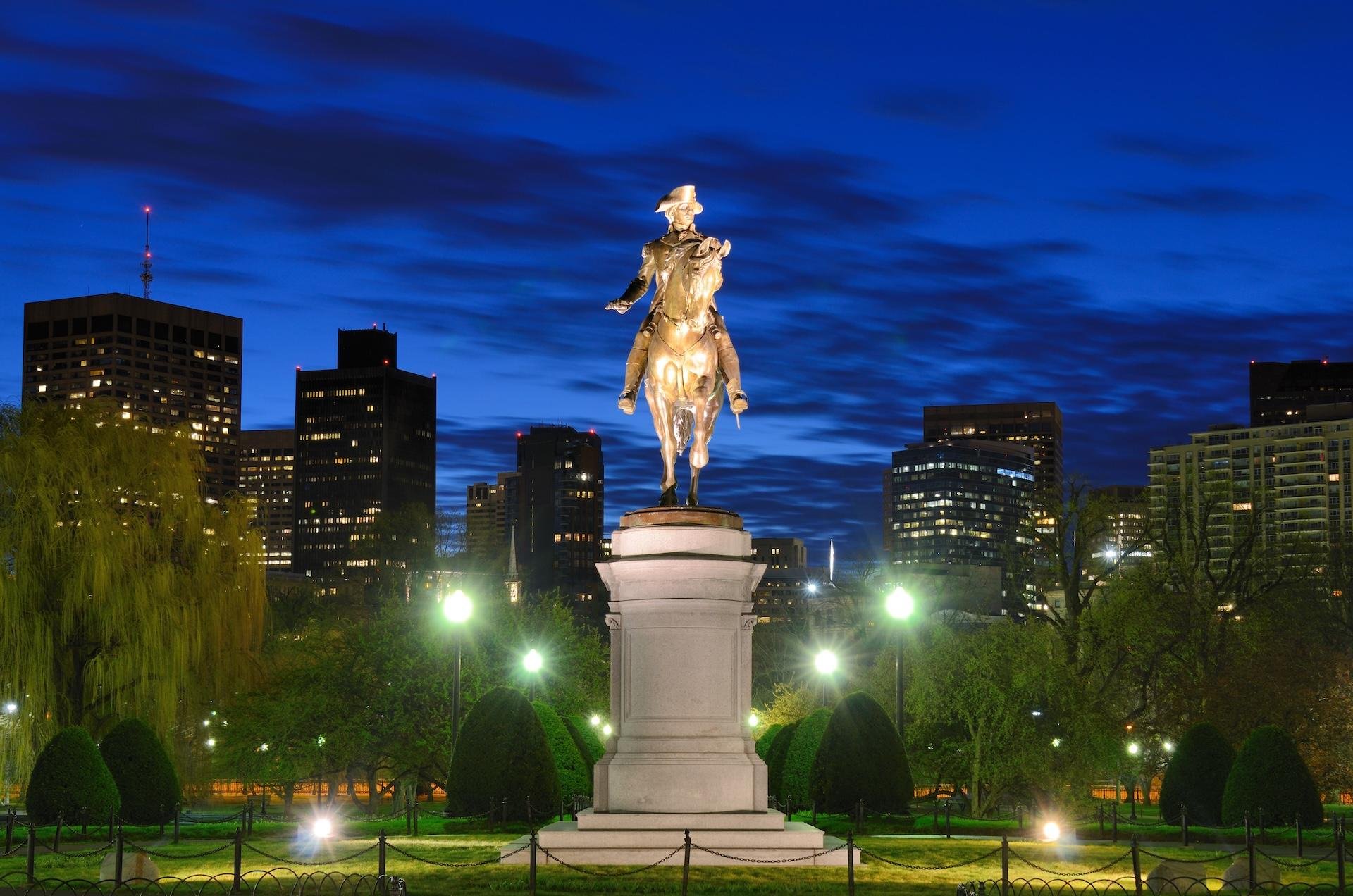
Mary Dyer was hanged on the Common on 1 June 1660. She was a Quaker at a time when Massachusetts banned Quakers on pain of death; she had already been banished, reprieved once on the gallows itself, and she came back anyway. Three others died the same way and are remembered together as the Boston martyrs. Her statue stands outside the State House at the top of the Common, a few minutes from where she died - one of the few places in the city where this history is stated plainly and for free.
There is a mass grave under the Common
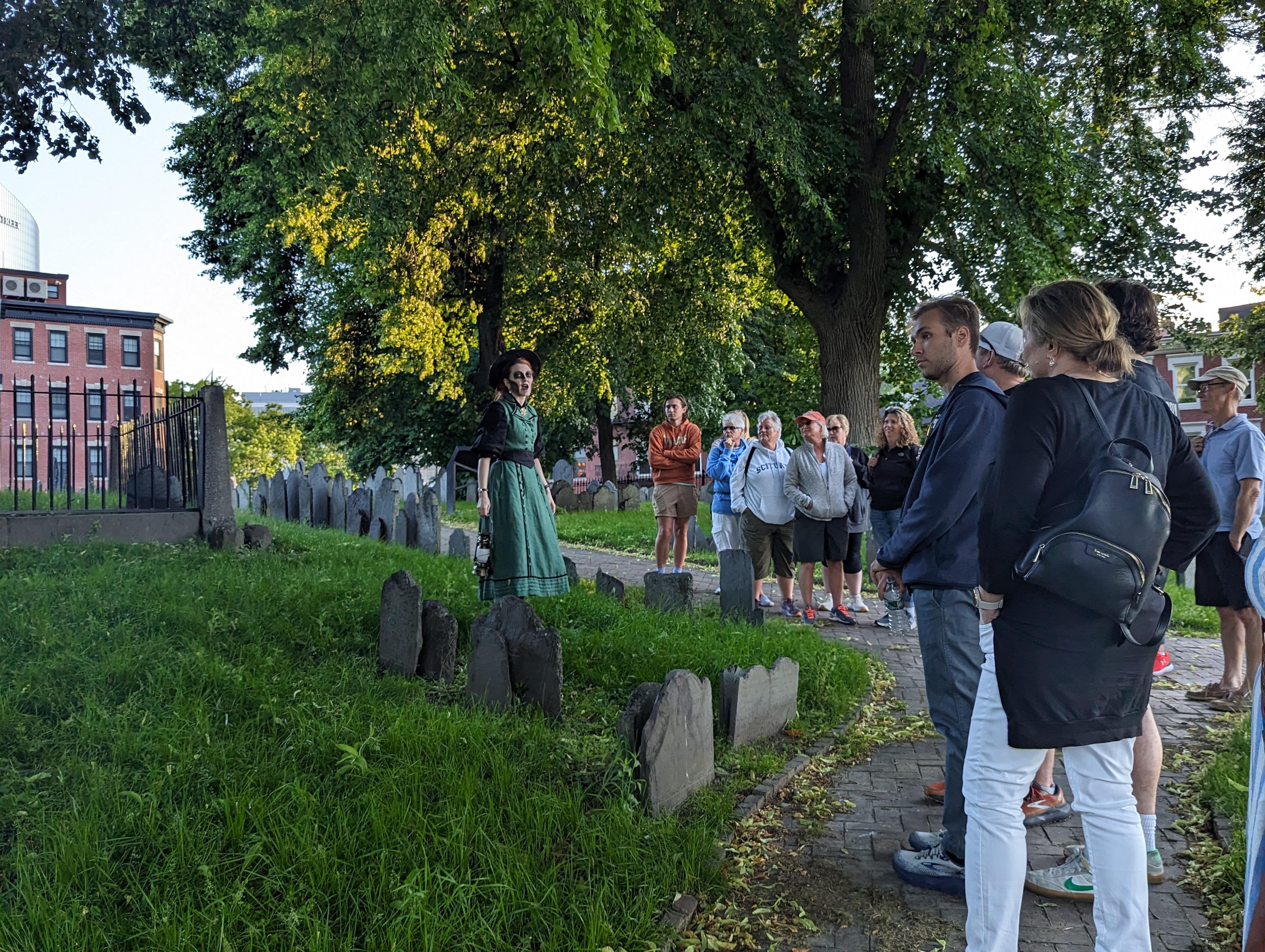
The Central Burying Ground opened in 1756 to take the overflow from King's Chapel, Copp's Hill and the Granary, and it holds the poor, the unclaimed, and soldiers of both sides from the Revolution. In the 1890s the Tremont Street subway - the first in the country - was cut through part of it. The remains that came up were reinterred together inside the cemetery wall under a stone carrying the date 1895. It is still there, a few steps off Boylston Street, and trains have run under the rest of the burials every day since.
Free, paid, and what a tour is for
The Common is a public park. The Central Burying Ground, the Granary, King's Chapel and Copp's Hill are free and open in daylight, and the Freedom Trail strings most of them together for nothing. The Omni Parker House, which collects more ghost stories than any building in Boston, is a working hotel - you can walk into the lobby, and that is the visit. So a Boston ghost tour is not selling access, because there is nothing here to unlock. It is selling the part the city left off the signs.
That sits in the typical band for the category, whose median is $30.
Boston ghost tours
5 of the 5 Boston tours we track
. Ordered by review depth.
Join a haunted pub crawl through Boston’s darkest taverns. Hear eerie tales of the Founding Fathers, sip where they drank, and walk the shadowy streets of the Revolutionary War.
Typical nationwide
$34.99
Typical for a ghost tour in Boston · 5 tours, median $32.50
Join the Ghosts of Boston Tour and explore haunted houses, eerie cemeteries, and ghostly Revolutionary War sites. Discover the spirits of American Patriots still roaming the city's historic grounds!
Typical nationwide
$29.99
Typical for a ghost tour in Boston · 5 tours, median $32.50
Explore the true crimes of the historic Beacon Hill neighborhood on a guided walking tour in Boston. Step into the dark history of the city while learning about famous murder cases and serial killers.
Typical nationwide
$35
Above the for a ghost tour in Boston · 5 tours, median $32.50
Explore the dark history of Boston on a 90-minute walking tour. Hear chilling tales of cursed artifacts, unsolved mysteries, & restless spirits as you explore eerie burial grounds & haunted locations.
Typical nationwide
$32.50
Typical for a ghost tour in Boston · 5 tours, median $32.50
By reputation, the Omni Parker House - open since 1855, and the source of most of the city's hotel ghost stories, including the founder Harvey Parker himself. By history, Boston Common: people were hanged there for witchcraft, for being Quakers, and for ordinary crimes, from the seventeenth century until 1817, and a mass grave from the 1890s subway works sits inside the Central Burying Ground at its edge. The Parker House has the stories. The Common has the bodies.
What's the scariest haunted house in Massachusetts?
That question is usually about seasonal haunted attractions - actors, sets and jump scares, mostly running in October, with the biggest cluster up in Salem - rather than about historic buildings. They are a different product from a ghost tour and worth not confusing: one is designed to frighten you, the other is a guided walk through places where something is documented to have happened. This page is about the second kind.
What is the best-kept secret in Boston?
For this subject, the 1895 stone in the Central Burying Ground on Boston Common. When the Tremont Street subway was cut through the cemetery in the 1890s, the remains that were disturbed were reinterred together in a mass grave inside the cemetery bounds and marked with that date. It is free, it is a minute from Boylston station, thousands of people pass over the rest of the burials daily, and almost nobody stops.
Were witches hanged in Boston?
Yes. Ann Hibbins was hanged on Boston Common on 19 June 1656, and hers was the third witchcraft execution in the town - all of it decades before the Salem trials of 1692. Nobody was burned in Massachusetts, in Boston or in Salem; hanging was the English colonial penalty. There is no memorial on the Common to any of them.
Are there any abandoned buildings in Boston?
Not really, in the way the question usually means - Boston is dense and expensive, and buildings that empty out get converted rather than left. The Charles Street Jail, which held prisoners until 1990 and appears on most haunted-Boston lists, is the clearest example: it is now a hotel, and you can walk into the atrium that used to be the cellblock. Ghost tours here work with occupied buildings and open ground, not ruins.
 1 hour